12 Tips for Optimizing Your YouTube Videos

Points for you for exploring video marketing!  You have scripted, filmed and edited your video, now all you have to do is get it out to the world. Beyond sharing your new video on your organization’s Facebook page, website and blog- you should also be sure to optimize your video on YouTube so that others on the interwebs can find your video.


Here are some tricks for making sure each YouTube video you upload is optimized:

  1. Key terms should be included in the video’s title. Focus on terms that patients would be using to search for your services on Google.
  2. Any branding terms should be at the end of the video’s title.
  3. Your video’s title should be under 66 characters so that it can be properly viewed in search results.
  4. Sometimes it helps if the word “video” is in the title.
  5. In the video description area, write a one to two sentence description of what the video is about.
  6. In those one to two sentences, be sure to include appropriate and relevant search terms along with branded key terms, i.e.: your practice name.
  7. Makes sure to include a URL linking to your website at the beginning of the description. This way, even if they only read the first line, they will see the CTA to explore more on your website.
  8. Tag your video so that search engines, YouTube and viewers know what the video is about.
  9. Key phrases should go in quotes, ex: Tampa vs. “Tampa radiology center” when using tags.
  10. Transcribe your videos with the script. It helps with SEO and gives your video the ability to include closed captioning. If you don’t want to show the script, simply disable the feature.
  11. Annotations can also be used for calls-to-action, ex: "Learn more about MRI’s" or “Read our spotlight on Dr. Smith.”
  12. Don’t over do it on the annotations.


Now, every video can’t have as much viral success as the classics, but if you have valuable and engaging content there is nothing stopping you!


RBMA Hot Topic: ICD-10 Implementation Perception

RBMA’s Hot Topic Question of the week relates to the impending implementation of ICD-10. For the last year the date of implementation has continued to be pushed back, leaving providers unsure when it will really go into effect.  Most providers seem to be pleased by it’s delay because it means they don’t have to learn the new coding system, but it is only a matter of time before we all will need to adapt to the ICD-10 protocols.


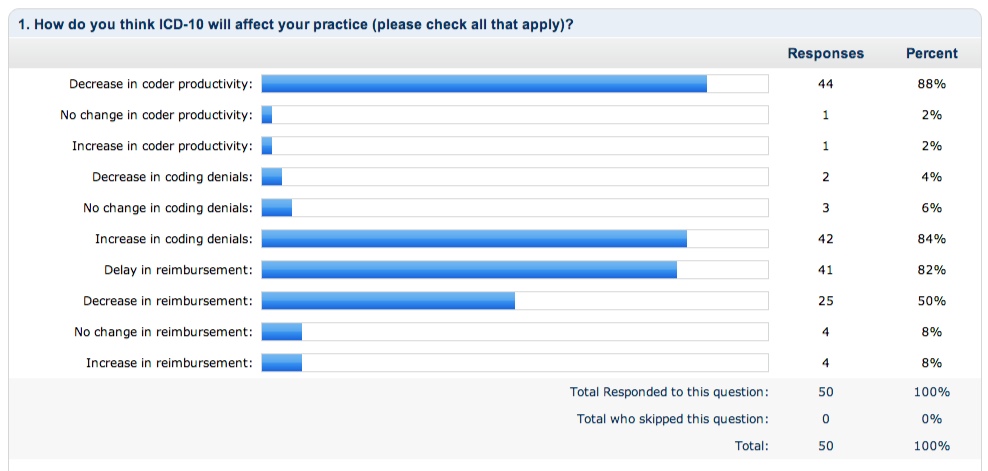
The RBMA took to the forums to find out for real how health care professionals in radiology feel about ICD-10 and how it will affect their practice.  The survey is still running, but the largely negative response is overwhelming.  Participants were asked, “How do you think ICD-10 will affect your practice? Check all that apply.”  Options included:


  •  Decrease in coder productivity
  • No change in coder productivity
  • Increase in coder productivity
  • Decrease in coding denials
  • No change in coding denials
  • Increase in coding Denials
  • Delay in reimbursement
  • Decrease in reimbursement
  • No change in reimbursement
  • Increase in reimbursement

Participate in the survey > Click Here

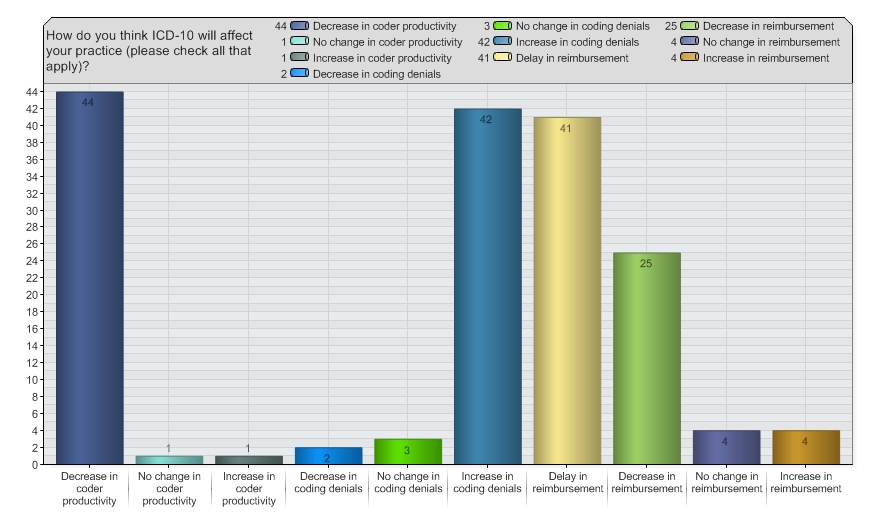
Currently, the most popular responses reflect the belief that implementation will bring decreased coder productivity, increased coding denials, delayed reimbursement and decreased reimbursement overall.


So, what’s with the all this ICD-10 hating? First of all, there are SO many changes with the new codes. (Review them all here: ICD-10 Education) It is intimidating, especially for those who are already not experts with ICD-9 coding.  Many practices and organizations have kept their revenue cycle management in-house for so long, in an effort to cut costs and keep control, but that trend will come to an end. 

In theory, ICD-10 should help physicians improve their reimbursements and cut down denials, however that is only if the codes are used appropriately. Heed the warning signs and start preparing now, because ready or not… ICD-10 is coming.

Health Care Problems Solved: Lowering Costs With Behavior Modification

The creative and innovative minds here at Atlantic Health Solutions are consistently searching for ways to transform the health care industry, growing to improve every aspect of care for patients and the providers we work with across the country. We pride ourselves on being the minds at the forefront of industry changes and that often means taking the road less traveled in health care.  The newest hot topic on the minds of the leaders in healthcare is population health management.

It’s believed that the improvement of the world’s health will lead to lower health care costs and spending but more importantly, healthier and happier lifestyles.

Elise Gould, the Directory of Health Policy Research at The Economic Policy Institute, reported that a whopping 80% of health dollars are spent by just 19% of health consumers. This essentially means then, that by targeting healthy patients to take actions to cut their costs is ineffective because we aren’t focusing on those who are responsible for the high spending. It seems that by improving upon modifiable risk factors in that pool of patients, we could save the U.S. billions of dollars. In fact, in 2011, the Institute of Medicine conducted a study, which showed that in 2009, $765 billion of health care expenditures were spent on things that could have been prevented.

According to a study by Deloitte, the uninsured are half as likely as the insured to go see a doctor for a routine check-up and 9 out of 10 consumers would classify themselves as being in good health but more than half of those patients ended up being diagnosed with one or more chronic conditions in 2010. What this study proves is that patients are, for the most part, unaware of their health conditions until it is too late, leading them to be responsible for high cost care when they could have just opted for lower cost preventative measures.

The new HABIT program, brought to you by Indaba Health & Wellness, solves the problem of health awareness and more. It is an interactive, online health management tool. Users take a health risk and DISCflex behavior assessment to create a customized behavior modification plan to become healthier.  People can set goals and objectives for themselves and participate in targeted eLearning programs to become more aware of their personal risk factors. 

Full behavior modification is a cycle of awareness, analysis, learning, goal setting, monitoring and achievement; HABIT makes it all possible and focuses on lowering risk pools and targeting chronic disease prevention.  Patients that use HABIT can take their health into their own hands.

Having this interactive tool as a resource for your patients also keeps your organization compliant with sections 4103-4108 of the Affordable Care Act, which discusses new compliance and billing requirements. The program tracks members’ annual wellness visits and includes digital timestamps, which is key for ACA compliance records.  The HABIT eMessaging then pushes out timely notifications to patients and providers to remind them of upcoming visits and steps they can take to become healthier like developing an exercise routine or remembering the monitor their cholesterol levels.

HABIT isn’t just a great program for health care providers. It has also revolutionized the way insurance groups, commercial insurance brokers and PEOs manage their members and helps corporate wellness groups motivate, monitor and incentivize their employees.


Want to give it a whirl yourself? Email marketing@atlantic-hs.com to get your free access login!

ACO Update: The Rise of Physician-Led ACOs


In the June issue of Health Affairs a study was published discussing ACO’s and the rise in physician leadership within the organizations.  One of the goals of the Affordable Care Act was to hold physicians more responsible for the care of their patients, by rewarding healthcare providers for improving the quality of care and lowering healthcare costs, the ACO model was born. Slow to start, ACOs have no risen in popularity, with more than 600 Accountable Care Organizations operating throughout the U.S.

What is an ACO? — An ACO is an accountable care organization made up of doctors, medical groups, hospitals, and other healthcare professionals who work together to deliver high-quality, coordinated care to the patients they serve.
— Healthcare Partners

There are many various types of ACOs, some are made up of solely primary care providers, others include a variety of specialists and others encompass hospitals and post-acute care providers. However, the study showed that physician-led structures seem to be operating best, meaning they are more likely to have complete care management programs, advanced IT programs and the most satisfied patients.

Former CMS Administrator, Dr. Mark McClellan attributes this to physicians’ personal experience and ability to identify areas for improvement firsthand and measure the impact of their efforts. The Director of the Dartmouth Institute and co-author of this study, Elliott Fisher, MD, MPH stated, “Physicians’ buy-in the payment reform is likely to be critical to the success of the health care reform.” He continued to say; “The findings suggest that physicians are taking seriously their responsibility to lead change in the health care system on behalf of their patients.”

It is certainly pleasing to know that physicians are in support of these changes and are taking on the responsibility of helping to ensure the betterment of care for their patients. As more ACOs are brought together, this report will help providers determine if the path is right for them and consider which structure is best.


To read more about how ACOs originated and to view statistics on the success some organizations have found, check out the Health Affairs blog here: http://healthaffairs.org/blog/2014/05/30/aco-results-what-we-know-so-far/